

Forehand Topspin – The Kinematic Chain
Courtesy of andro Table Tennis Coach Jens Stoetzel
There are tons of instructions how to play a forehand topspin (short form: FHT). All these instructions have many things in common while they differ only in a very few points. But when you take a look at the pro’s topspin strokes you can easily see that every player has found his own style.
Although they have always the same target: generating the best possible acceleration when the racket hits the ball!
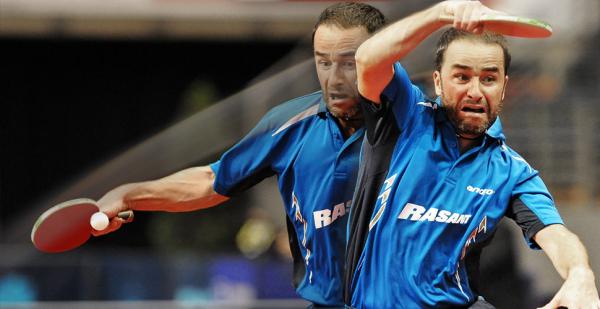 Professional players are the best proof that the way to this target can vary. The physical constitution, rubbers, blades and the technical education have a huge influence on the player’s technique. Though a few key points – based on biomechanical rules – are valid for every player:
Professional players are the best proof that the way to this target can vary. The physical constitution, rubbers, blades and the technical education have a huge influence on the player’s technique. Though a few key points – based on biomechanical rules – are valid for every player:
- Weight transfer from the right to the left leg (valid only for right-handers)
- Hip rotation
- Rotation of the body’s upper part
- Forearm acceleration
- Using your wrist joint
- Just stand up straight and let your arms hang down loosely beneath your body. Now pull back your right hip first and then push it dynamically to the front. You should feel now that right arm first moves back and then starts to swing to the front. This is exactly the starting move of your arm at the beginning of a FHT.
- Stand up straight in front of a wall, turn your back to the wall and let your arms hang down again as done before. Starting from this position you should try now to throw a table tennis ball as far as your can in front of you. You might feel that the impulse is coming from your right leg and that your right hip is turned to the front at the end of this move. By the way: the point where the ball leaves your hands is exactly the point where the acceleration has reached its maximum. This is also the point where you should hit the ball when you are playing a FHT.
- Try andro's complete line of Blades, Rubber, Paddles, and Accessories!
- andro's Rasanter Rubber is available in all spin and speed profiles
Tags:
Previous post
2018 ITTF Team World Cup - Ma Long & Fan Zhendong Training
Next post
6 of the Most Commonly Asked Questions About Table Tennis Equipment
Related Posts

Anders Lind Breaks Down His WTT Contender Lagos Win
Anders Lind is back on top in Lagos. In his latest video, Anders walks through his WTT Contender Lagos 2026 title run, where he...
Jun 01 2026

Looking Back: Charlie Wuvanich and the Spirit of an Era
Some players are remembered for titles. Others are remembered for the way they changed the people around them. Charlie Wuvanich somehow did both. Originally...
May 13 2026

Harvard’s Kelly Yenn Wins Big at NCTTA Nationals, On and Off the Table
The latest episode of the NCTTA “Off The Table” podcast gave fans a deeper look into one of college table tennis’ brightest stars, Harvard’s...
May 12 2026

The Limit of Talent: Why Development Matters More Than Gifts
One of the most common conversations in sports is about talent. Who has it.Who doesn’t.Who was “born special.” After nearly 50 years in table...
May 12 2026

2026 Minnesota State High School Team Table Tennis Championships
The future of American table tennis was on full display at the 2026 Minnesota State High School Team Table Tennis Championships, as students from...
May 08 2026

Paddle Palace Spring Teams Event Brings High-Level Matches and Breakthrough Moments
The Paddle Palace Spring 2-Person Teams & Giant Round Robin brought together a strong mix of rising juniors, experienced club players, and tough competitors...
May 05 2026

A Weekend with Jiwei Xia at Micro Motion Table Tennis Academy
Paddle Palace sent head coach Jiwei Xia to the Bay Area to work directly with the Micro Motion Table Tennis Academy community. Jiwei spent...
Dec 03 2025

2025 Oregon State Table Tennis Championships
November 8, 2025 – Tigard, Oregon The Paddle Palace Club buzzed with excitement as players from across Oregon came together for the 2025 Oregon...
Nov 11 2025


