
Stage Three - Table Tennis Training for the Olympic Trials
Stage Three - Training for the Olympic Trials
By Samson Dubina
My choice of racket is a Nittaku Ludeak - composed of 85 grams of 7-ply all-wood construction. This blade gives me the right weight and power for my mid-distance counterlooping style. The Ludeak blade teamed with Narucross EX Hard rubber is the perfect combination. Narucross EX Hard is one of the world's fastest rubbers and unlike many other tensor rubbers, Narucross has great touch for the short game.
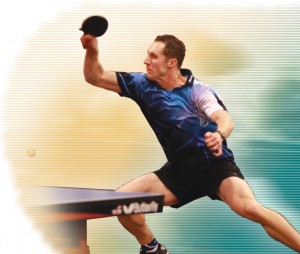 It’s now October 1st, and I’m eagerly moving forward to stage three of my training for the Olympic trials. During the first two stages, I was able to boost my physical conditioning, make some slight changes in my technique, and become overall more consistent in drilling. This article will outline some details about stage three: my drills, my physical training, my tournaments, and my improvements.
I have now become very consistent in looping 10-12 balls each rally while my opponent blocks to
random locations. This is the base technique that I worked toward in stage two; however, this is not how a real game is actually played. In stage three, I’ll now be doing the same drills, but starting with a serve.
I initially want to make sure that my long game is solid. For a couple weeks during the month of October, I’ll be focusing on serving, having my trainer push long or flip, then playing the rally. Once I’m able to accurately loop the push or flip, I will add more variation to my opening loop by intentionally contacting the ball earlier or later, playing more spin or more speed.
Next, I’ll add the short game. After I serve, my training partner will receive short, I’ll flip to his backhand, then continue the drill. In November, I’ll add all the elements together. I’ll serve short sidespin or backspin, my training partner will push short, push long, or flip; then I’ll flip or loop to his backhand, he will block random, and I’ll continue looping to his backhand. If there are inconsistent areas of my game, I’ll go back to the basics and center my attention on those areas in more detail. If my short game, long game, and rallies are very concrete, I’ll ask my training partner to add more variation in his serve returns and blocks.
Each day, I’ll also do the same footwork drills but have my partner serve for two drills. Drill one is looping serves; I’ll have him serve any spin medium or long. After attacking the serve, I’ll continue the footwork drill and try to maintain a rally of at least ten balls. Drill two is practicing my flip; I’ll have him serve short, followed by my flip, followed by the rally.
At the conclusion of each session, I’ll play a couple games. In the matches, I should feel that all the pieces of the puzzle are now coming together to form a solid game structure.
During stage three, I will focus less on physical conditioning. In the previous two stages, I needed to build a base of strength through weight-lifting and endurance through distance running. In this stage, I want to spend most of my time practicing table tennis specifically. I will be doing about twenty minutes of physical training, but most of this will be to improve my speed, not my strength. After table tennis practice each day, here are the exercises that I regularly perform:
Monday – 15 sprints (400 meters)
Doing each set progressively faster
Walking 30 seconds between each sprint
Tuesday – 1-legged stair hopping
Three flights of stairs with each foot
Resting 30 seconds between sets and completing 10 sets total
Thursday – calisthenic speed training (push-ups, pull-ups, dips)
Continual circuit workout with no rest between sets
Friday – 15 sprints (400 meters)
Doing each set progressively faster
Walking 30 seconds between each sprint
Saturday – running stairs
Focusing on speed
Eight flights of stairs repeated 10 times
With a very short workout, it doesn’t take much time away from my practice, yet it still improves my speed and helps maintain the base of conditioning from stages one and two.
During stage three, I plan to compete in seven tournaments. In these competitions, I will now be able to combine together the things that I’ve beeb practicing. After each match, it will be vitally important for me to record what went right and what went wrong. During the week, I’ll be studying these tournaments and improving for the next one.
Not only will I be thinking about my own game, but I will also be scouting my rival for the Olympic trials. Watching my opponents will give me a good idea on what to expect and how I should practice to beat them. Ideally, I would like to have a video of myself playing against each of them so that I can study it in more detail.
In the last couple months, I have made three positive changes to my game. First, I am using more wrist on both my forehand and backhand loops. This allows me to play in different gears and easily change the speed and spin, without signaling the changes to my opponent. Now, my opponents don’t feel as comfortable blocking my loop, and I’m also able to place the ball with more accuracy. Second, I improved my in-and-out footwork. By taking one extra mini-step, this allows me to get in better position to loop the ball at the top of the bounce. This is very important, especially when playing a blocker that varies the pace on his block. Finally, I improved my forehand power. By opening my stance more, I’m able to turn my hips and shoulders more easily to generate power with my body. These three improvements will help boost my level to be the best possible shape of the Olympic trials.
Wang Liqin Multiball video in Rotterdam, May 2011
Kim in a "SPiN" (SPiN New York Table Tennis That IS)
Related Posts

Anders Lind Breaks Down His WTT Contender Lagos Win

Looking Back: Charlie Wuvanich and the Spirit of an Era

Harvard’s Kelly Yenn Wins Big at NCTTA Nationals, On and Off the Table

The Limit of Talent: Why Development Matters More Than Gifts

2026 Minnesota State High School Team Table Tennis Championships

Paddle Palace Spring Teams Event Brings High-Level Matches and Breakthrough Moments

A Weekend with Jiwei Xia at Micro Motion Table Tennis Academy


